EXTENDED READING · CORE FORMULA
The Value Cube, Three Readings of the Formula
Macro Y=E×S×T and micro y=f(m)×f(h)×f(t) are the same cube projected twice
This page is an extended reading of the “Core Formula” section of The Value Conservation Law. The main text gives two formulas and six statements of the law; here they are folded back into geometry —every variable in the formula is an edge, and the multiplication sign is the volume. Once folded, three rules that look unrelated in the main text turn out to share one source: ① a variable at zero puts the total at zero; ② only when all three variables exceed 1 does the system enter expansion; ③ any variable falling into the 0–1 band will destroy the value of the other two. They are not three independent empirical rules but three statements of one geometric fact— in the world of multiplication, one edge alone decides the whole volume.
Just as energy is conserved throughout nature, so — seen across the economy, society and the people as a whole —economic value, social value and time value are neither created from nothing nor destroyed; they only convert from one form into another, or transfer from one subject to another, while the total quantity of value stays constant.
Macro: Y = E × S × T = economic value × social value × time value = total economic-social value (As read here: Y is the cube's volume, and E / S / T are its three edges. The macro layer reads totals — the total value of a country, a market, a society is the product of these three edges.)
Micro: y = f(m,h,t) = f(m) money value × f(h) felt wellbeing × f(t) time value (As read here: y is the isomorphic other cube, and m / h / t correspond one-to-one with E / S / T. The only difference is the f( ) — it marks felt experience rather than totals: a person's sense of money and of wellbeing is nonlinear, so the same sum does not feel the same at different stages.)
In One Sentence
This page sets out to answer one question: why the formula must be written with multiplication signs. Read Y = E × S × T as “the product of three edges”, and three conclusions usually discussed apart collapse into one sentence: there is no local safety in the world of multiplication — one edge alone decides the whole volume.
Three actions follow, and their order cannot be reversed: ① first confirm whether any edge equals zero (if so, the other two can be as high as they like — it no longer matters); ② then confirm whether any edge sits in the 0–1 band (if so, it is actively shrinking the other two); ③ only then talk about raising all three edges together. The first two steps stop the bleeding; only the third is growth. Reversing the order is the most common misuse — pouring every resource into one edge while another sits at zero.
The conservation the law describes is conservation of the total ; and a conserved total means precisely that the shape can vary endlessly. This explains an easily misread fact: with the same 8 units of volume, 1×1×8 (a long rod), 2×2×2 (a cube) and 1×2×4 (a flat slab) have completely different resistance to shock. So “conserved” is not a comfort; it is a reminder — the only thing you have to manage is not whether the total is enough, but how the three edges are allocated.
Coordinates · The Same Cube, Projected Twice
The macro section of the main text gives two expressions (Y = E × S × T, and Y = y₁ + y₂ + y₃ … + yₙ); the micro section gives y = f(m,h,t) = f(m)×f(h)×f(t). Both use the same coordinate system, and only the reading differs: macro reads totals, micro reads felt experience.
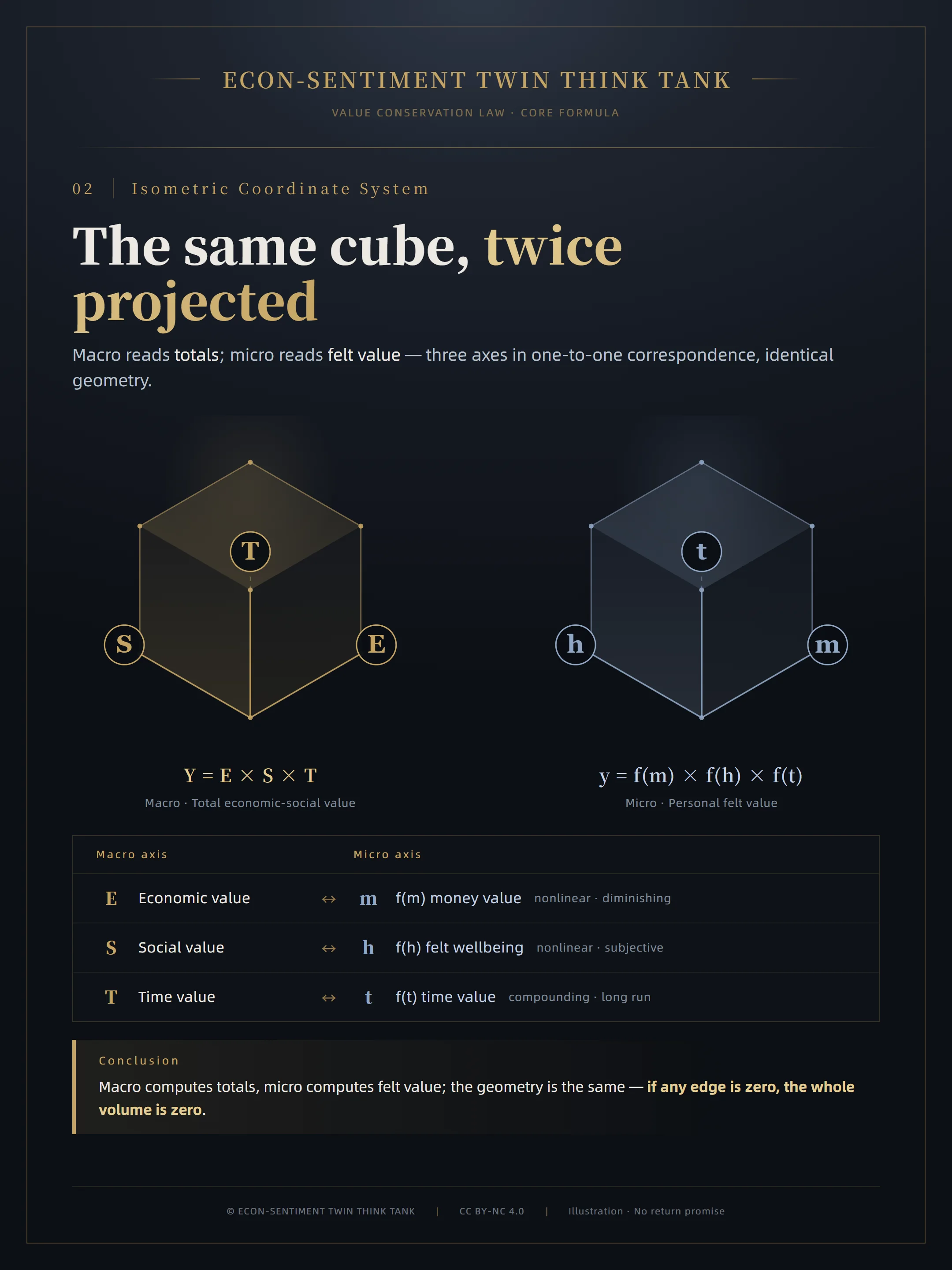
How to read this plate: Edge length = the magnitude of that dimension; volume = the total value. The three visible faces (right face darkest, left face next, top face brightest) are only tonal layers and do not represent differences between variables — differences are expressed only by edge length.
Three Axes · One-to-One
The macro and micro axes are two readings of the same axis; the only difference is the f( ) in brackets.
| Macro axis | Micro axis | How the reading differs |
|---|---|---|
| E Economic value | m f(m) money value | nonlinear · diminishing |
| S Social value | h f(h) felt wellbeing | nonlinear · subjective |
| T Time value | t f(t) time value | compounding · long run |
Three Geometric Facts
Every line of copy on these plates rests on these three. They are not rhetoric; they are geometry.
① Multiplication is not addition
In addition, one term less is only a little less; in multiplication, one edge less and the whole volume is zero. So if any of E / S / T is 0, Y is 0 — there is no such thing as “high economic value making up for social responsibility”.
② Double all three edges = 8×
2 × 2 × 2 = 8, not 2 + 2 + 2 = 6. That is the entire difference between multiplication and linear addition, and the mathematical origin of the phrase “value can be multiplied”.
③ Two projections, not two systems
The three axes correspond one-to-one (E↔f(m), S↔f(h), T↔f(t)); only the reading differs. The micro axes carry an f( ) because a person's sense of money and wellbeing is nonlinear — the same sum does not feel equal at different stages.
Reading I · Macro Adds, Micro Multiplies
The macro section of the main text gives two expressions at once: Y = E × S × T and Y = y₁ + y₂ + y₃ … + yₙ. The second is usually read as a gloss on the first, but it is really an operation on a different level: the outer layer adds (between one subject and another), while the inner layer must multiply (inside a single subject).
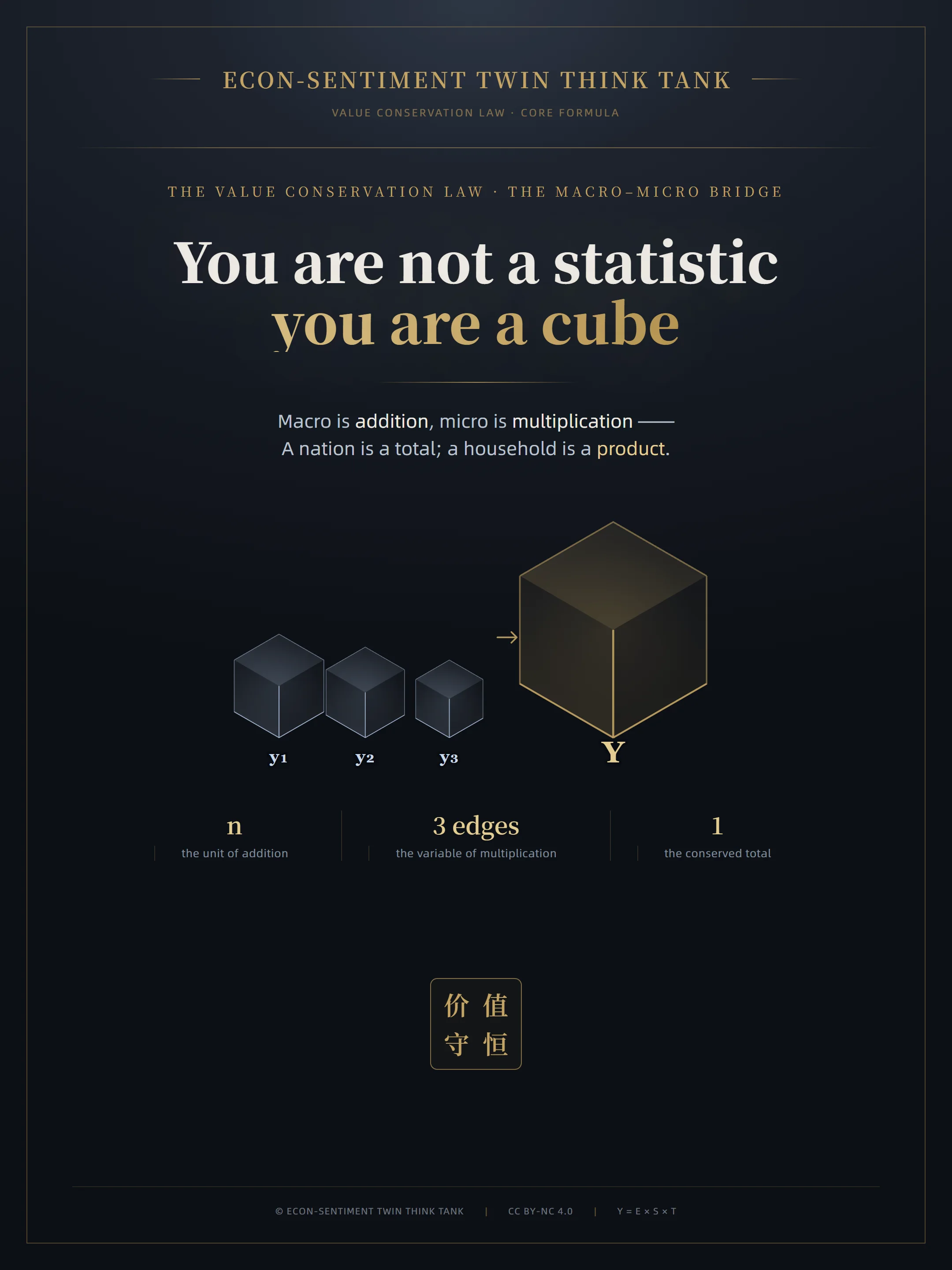

Macro: Y = E × S × T = economic value × social value × time value = total economic-social value; Y = y₁ + y₂ + y₃ … + yₙ
Micro: y = f(m,h,t) = f(m) × f(h) × f(t)
See the main text: § The Value Conservation Law › Macro · § MicroThe World of Addition and the World of Multiplication
One event, two operations, losses of a completely different nature.
| Layer | Operation | If an edge is missing | Nature of the loss |
|---|---|---|---|
| Outer · between one subject and another | Addition Y = y₁ + y₂ + ⋯ + yₙ | Lose a piece and you lose a piece | Local · usually restorable |
| Inner · inside a single subject | Multiplication y = f(m) × f(h) × f(t) | One edge to zero and the whole cube vanishes | Total · beyond repair |
The macro formula has no fourth variable — it simply sums the volumes of n micro cubes. So when one household's volume goes to zero, the total really does lose a piece.
The reverse holds too: what macro sees as “growth” must appear at micro level as “some person whose three edges have not all collapsed”. Otherwise it is not growth, only volume carried over from somewhere else.
Reading II · Value Never Disappears, It Only Changes Shape
The first line of the law's statement is conservation itself: value only converts and transfers, the total never changes. And if the total never changes, only one real question is left —allocation.
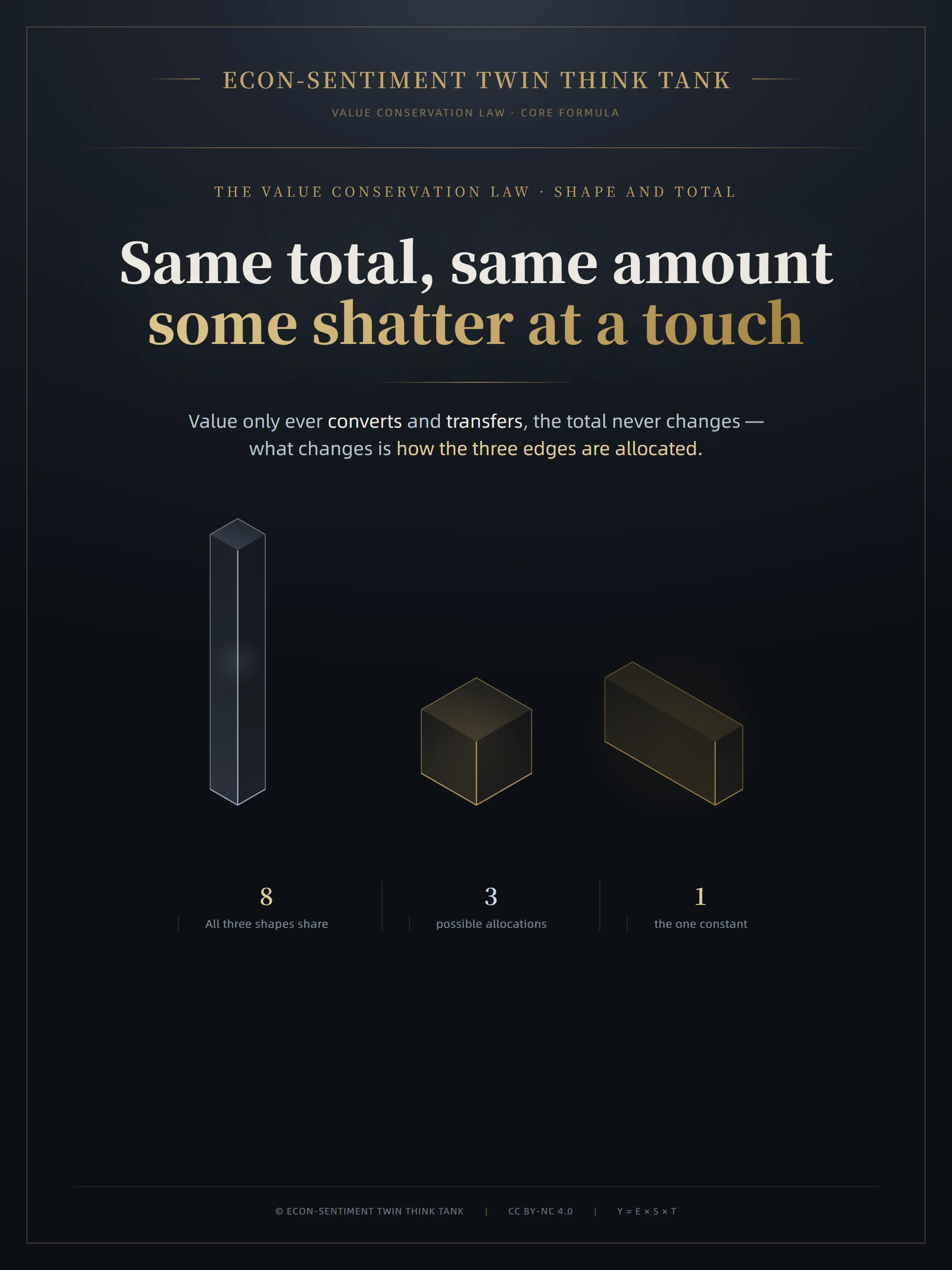
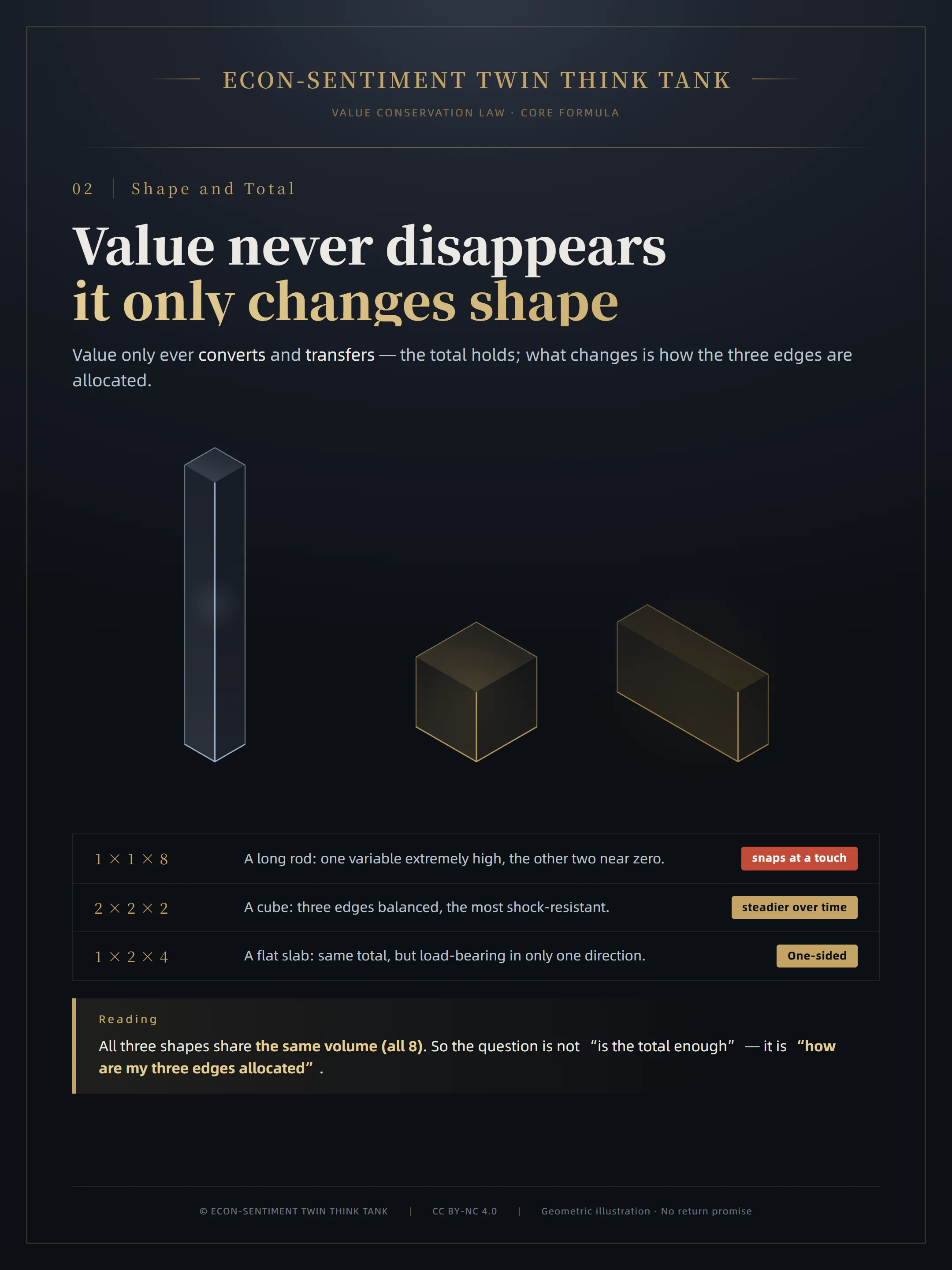
Economic, social and time value are neither created from nothing nor destroyed; they only convert from one form into another, or transfer from one subject to another, while the total quantity of value stays constant.
See the main text: § The Value Conservation Law › Statements of the LawThree Shapes · One Total
All equal to 8 in volume, yet structurally completely different.
| Shape | Geometric meaning | Shock resistance |
|---|---|---|
| 1 × 1 × 8 | A long rod: one variable extremely high, the other two near zero | snaps at a touch |
| 2 × 2 × 2 | A cube: three edges balanced | steadier over time |
| 1 × 2 × 4 | A flat slab: same total, but load-bearing in only one direction | One-sided |
All three shapes share exactly the same volume (all 8). So the question is not “is the total enough” but “how are my three edges allocated”.
There is one counter-intuitive point here: a conserved total does not guarantee safety; it only guarantees that waste does not vanish into nothing. A 1 × 1 × 8 structure can outrun a 2 × 2 × 2 in good times; its fragility shows only when one edge begins to contract — which is exactly the moment it is hardest to notice.
Reading III · 1 Is the Only Watershed in Multiplication
The two hardest statements of the law circle the same number: 1. This reading also gives the page's only ordered course of action.
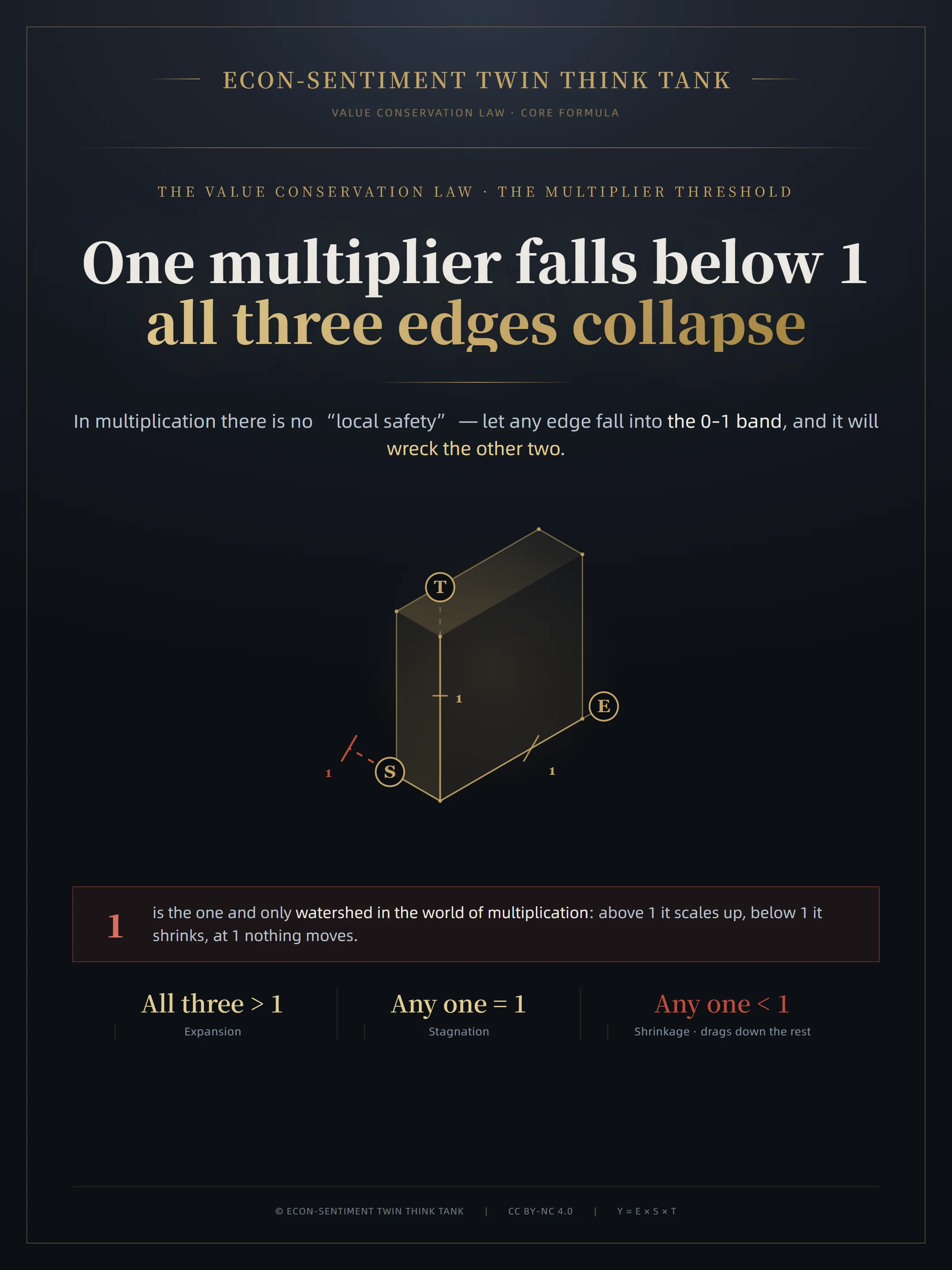
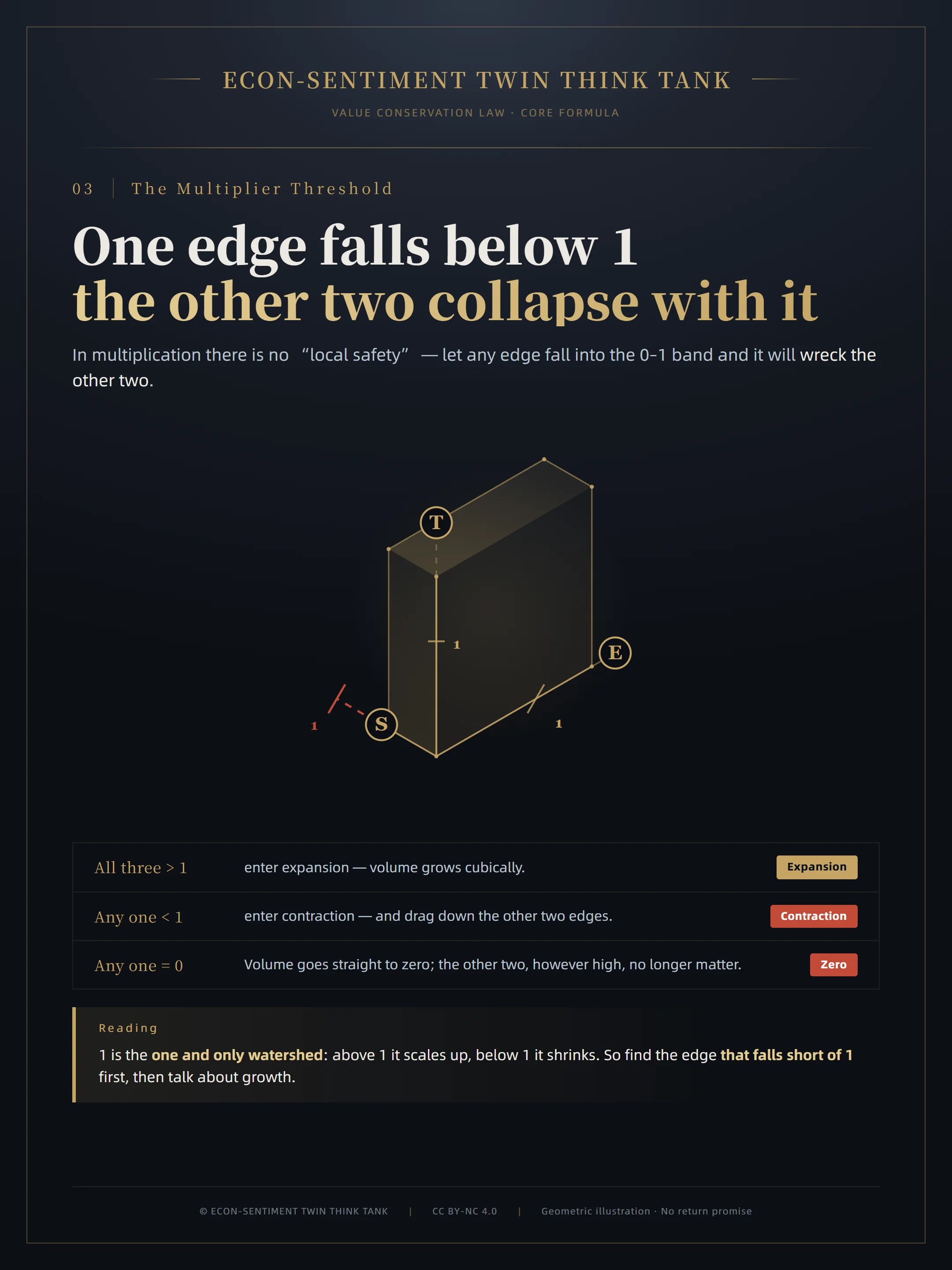
② Only when all three variables exceed 1 does the system enter development and expansion.
③ When any variable sits in the 0–1 band (0<X<1), the system enters contraction and decline, destroy the value of the other two, and the total economic-social value is affected in turn.
See the main text: § The Value Conservation Law › Statements of the LawThree Edges · Three States
1 is a watershed, not a safety line.
| State | Geometric reading | Conclusion |
|---|---|---|
| All three > 1 | all three edges expand together, volume grows cubically | Expansion |
| Any one < 1 | that edge is shrinking, and drags the other two down multiplicatively | Contraction |
| Any one = 0 | volume goes straight to zero; the other two, however high, no longer matter | Zero |
1 is the only watershed in multiplication: above 1 it scales up, below 1 it shrinks, at 0 it zeroes out.
Falling below 1 is far more serious than “growing a little slower” because there is no local safety in multiplication — a multiplier of 0.8 takes 20% off the results of the other two edges as well. So the order is always: find the edge that falls short of 1 first, then talk about growth.
The Three Readings at a Glance
All three readings share one seal-based visual system and one isometric base; they differ only in geometric form and the question they point at.
The Three Readings at a Glance
Each reading folds a sentence already written in the main text; none adds a new conclusion.
| Reading | In one line | Which sentence it folds | Geometry on the plate |
|---|---|---|---|
| Reading I | Macro adds, micro multiplies | Y = E×S×T and Y = y₁ + y₂ + ⋯ + yₙ both hold | n small cubes merge into one total |
| Reading II | Value never disappears, it only changes shape | the total quantity of value stays constant | three equal-volume shapes side by side, sharing a base |
| Reading III | 1 is the only watershed in multiplication | all three variables > must exceed 1 to expand; any one in the 0–1 band wrecks the other two | a single cube + 1-marks; one edge falls below |
Verbatim Voiceover Script
The verbatim script that accompanies Figure 1 · The same cube, projected twice. It can be read aloud as written.
We are used to doing the arithmetic of life by addition: a little more salary, a little more savings, a little more seniority.
But the true shape of wealth is not a line; it is a cube.
Economic value, social value and time value are its three edges.
In the world of addition, one term less is only a little less; in the world of multiplication, one edge less and the volume goes straight to zero.
So the real question was never “should I try a little harder”,
but “which edge of mine is actually zero”.
The last line is where the whole piece lands: do not rewrite it as a statement — it must stay a question, because this page offers not a conclusion but a self-check.
Design Archive · Three Directions
This set was developed in three design directions on one shared “seal” visual system (deep navy ground + fine gold frame + heavy serif display + gold number seals, 1080 × 1440 portrait). The adopted direction appears in the body; the other drafts are archived here for comparison.
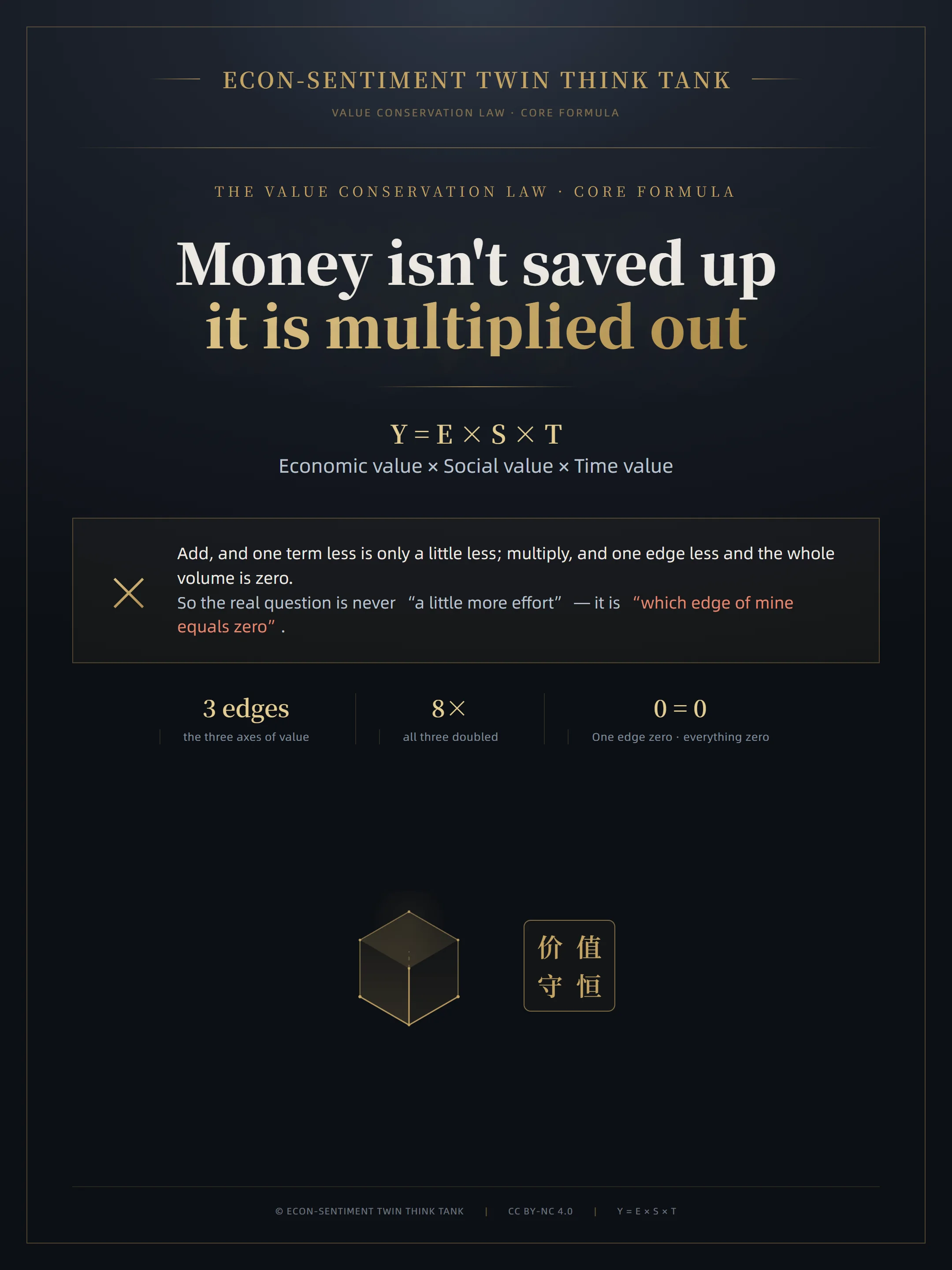
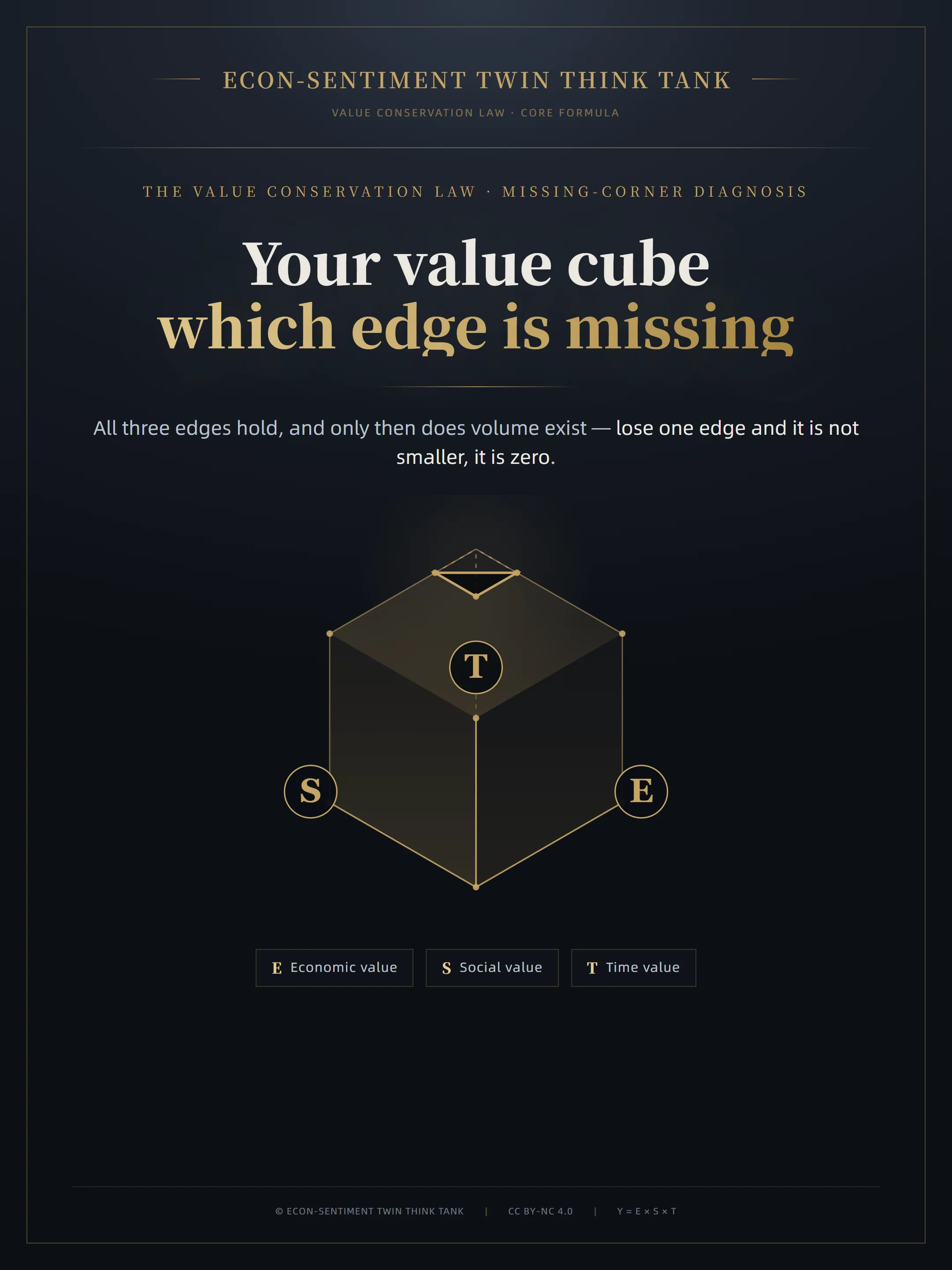
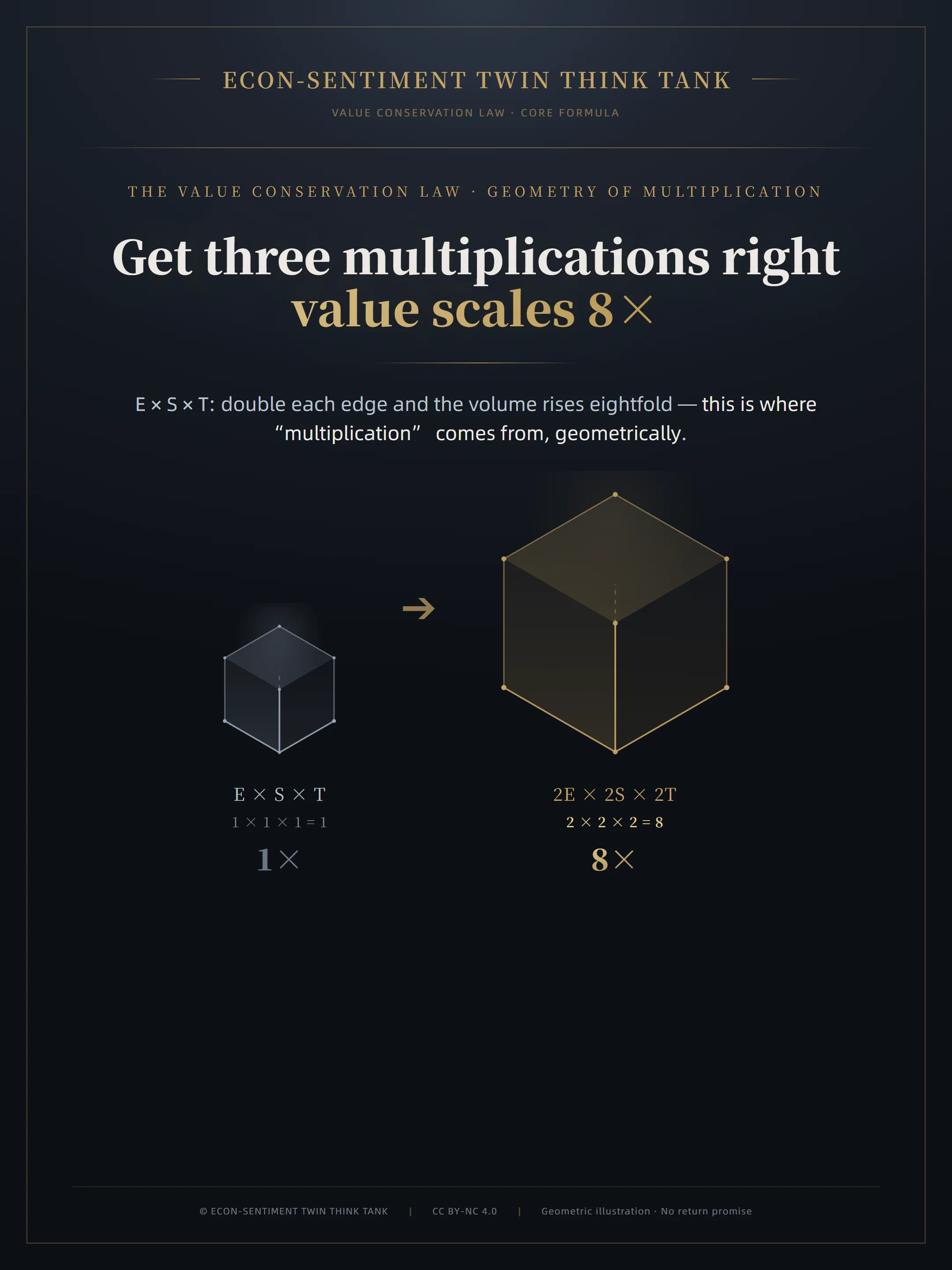

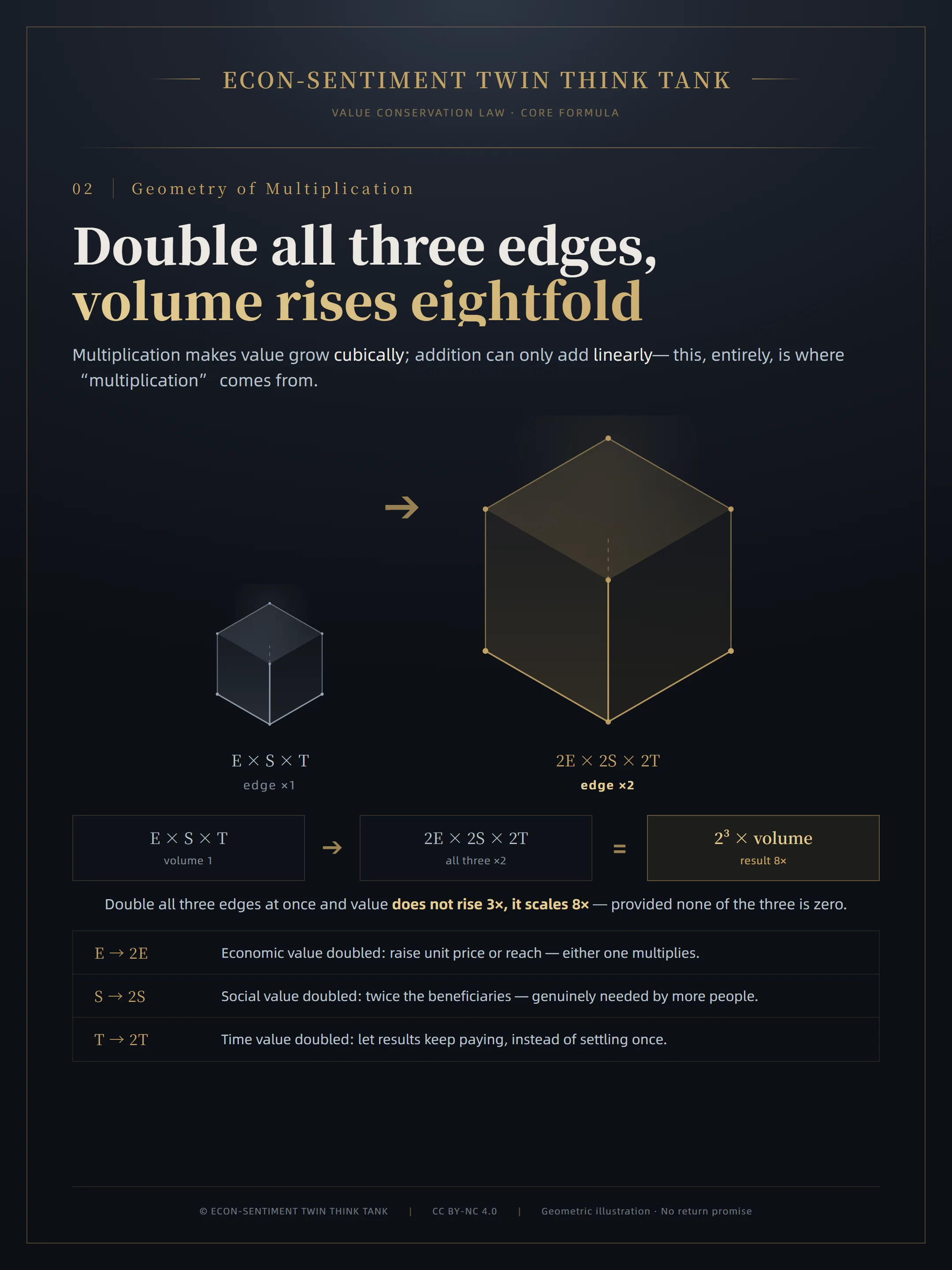
The axis of difference between the three: they share one set of brand assets (the seal visual system); the difference lies in geometric form and the question they point at — A uses type to create cognitive conflict, B uses the missing corner to open a curiosity gap, C uses a multiple comparison to convey gain. Same brand, different reading.
How to Read the Plates · Sources
1Content basis: the main text of The Value Conservation Law for Wealth–Wellbeing Multiplication, § The Value Conservation Law › Statements of the Law, Macro, Micro. This page only performs a geometric folding and adds no conclusions; where the two differ, the main text governs.
2Plate sources: the video/podcast plate projects vcl-unified-cube (two-formula isometric coordinate system; cover + main plate) and vcl-cube-readings (three creative readings of the value cube, each with cover + main plate).
3Specification: 1080 × 1440 (3 : 4 portrait) · isometric 30° · deep navy ground + fine gold frame + heavy serif display + gold number seals · fixed footer © ECON-SENTIMENT TWIN THINK TANK | CC BY-NC 4.0 | Y = E × S × T.
4On-site formats: the 12 source PNGs total about 13.1 MB; converted uniformly to WebP (q=84) on site they total about 1.50 MB (about 11.5%), with no cropping or rescaling of size or composition.
Note: phrases on the plates such as “the watershed at 1” and “wrecks the other two edges” come from judgements the main text makes about groups and systems, and must not be cut down into an assessment of any particular individual. Licensed CC BY-NC 4.0; contains AI-assisted creation.
FAQ
Six questions that come up often
Q1 Why must the formula be multiplication — why not a weighted sum?
A weighted sum (aE + bS + cT) allows one term to cover for another — E high enough buys back a missing S. Multiplication allows no such compensation: any edge at zero puts the total at zero. This is not a mathematical preference but a judgement about reality: neither a society nor a person acquires social and time value simply by producing a great deal of economic value; a missing thing is really missing.
Q2 What does the f( ) in the micro formula mean? Can it be dropped?
No. The macro axes measure totals; the micro axes measure felt experience, and felt experience is nonlinear: the same sum brings completely different wellbeing above and below the subsistence line (diminishing marginal returns). The f( ) is that nonlinearity. Drop it and the micro formula degenerates into “the macro formula with different letters”, losing all power to explain individual differences.
Q3 If all three variables must exceed 1 to expand, does “holding at 1” mean safety?
No. 1 is a watershed, not a safety line. Note the wording of the text: any variable in the 0–1 band “destroys the value of the other two”. That means it is an active drag, not passive stagnation. So the real move is not to hold at 1 but to find the edge that is hugging 1 .
Q4 Are figures like 1 × 1 × 8 statistics?
No. They are all a geometric illustration, used to show volume relationships; they come from no measured statistics and cannot be used for individual attribution. Where this page quotes the main text, the only numbers are the formulas themselves (Y = E×S×T, y = f(m)×f(h)×f(t), Y = y₁ + y₂ + ⋯ + yₙ).
Q5 How does this page relate to the main text? Could the two conflict?
The main text gives the formulas themselves and the six statements of the law; this page is one geometric folding of it — it adds no conclusions, only translates existing sentences into shapes you can look at directly. Where the two differ, the main text governs.
Q6 Can I use these plates in my own content?
Yes — under CC BY-NC 4.0 you may quote, translate, adapt and share them freely, but not for commercial purposes, and you must attribute the work and keep the licence notice. Please also keep the footer and disclaimer on the plates; phrases such as “the watershed at 1” must not be cut down into an assessment of any particular individual.
In the world of multiplication, no edge is incidental.
So the real question was never “should I try a little harder” — it is “which edge of mine is actually zero”.